


Mice in your car, how to protect the cables
You start the car on a cold morning and suddenly a warning light comes on. Or you find a small nest of insulation, paper and leaves under the bonnet. Chances are mice have been in your car.
In this article you will read why mice crawl into the engine bay in autumn and winter, how to recognise the signs and how to protect the cables.
Why mice move into cars in autumn and winter
As soon as it gets colder outside, mice look for a dry and warm place. An engine that has just been running stays warm for hours. The engine bay also offers shelter from wind, rain and predators. For a mouse that is an ideal hiding place, especially if the car is parked at night next to a shed, hedge or field.
Mice do not gnaw because they are hungry. Their front teeth keep growing throughout their lives, so they wear them down on whatever is nearby. In a car that is often cables, hoses and insulation. More and more car manufacturers use plant-based materials for cable sheathing, and rodents seem to find these particularly attractive.
How to tell if there are mice in your car
You rarely see mice, but you do see their traces. Look out for these signs:
- Nesting material. Bits of insulation, paper, grass or leaves on the battery, near the air filter or behind the engine cover.
- Droppings. Small black droppings of a few millimetres, often in corners and on the battery tray.
- Gnaw marks. Frayed edges on cable sheathing, hoses or the insulation mat under the bonnet.
- Faults. A warning light, a sensor that fails or a car that is hard to start, with no obvious cause.
- Smell. A musty or sour smell from the ventilation, especially just after switching it on.
If you see gnaw marks on cables or hoses, have the car checked by a garage. A chewed brake hose or fuel line is a safety risk, and a damaged cable can still cause a short circuit later.
What you can do yourself to keep mice out of your car
A few simple measures make your car a lot less attractive:
- Remove food. Do not leave crumbs, sweets, bird seed or dog food in the car or garage. Food attracts mice, even inside a bag.
- Choose where you park. Avoid parking right next to a hedge, log pile, compost heap or field. An open spot on the street or a closed garage is better.
- Clear out nesting material. Mice return to a place where a nest already exists. Remove the material wearing gloves and clean the area.
- Keep the garage sealed. Close gaps and holes around the door and pipe openings. A mouse can fit through an opening of about half a centimetre.
- Drive regularly. A car that stands still for weeks, for example in winter storage, is a quiet nesting spot for mice. Check under the bonnet regularly.
Also read our article about mice chewing on cables in the house, crawl space and shed. It has more tips on closing off entry points.
Why popular home remedies often disappoint
There are plenty of home remedies against mice in cars online. Most of them only help briefly or not at all:
- Scent sachets and peppermint oil. The smell fades within a few days, especially in an engine bay that keeps heating up and cooling down.
- Dryer sheets or soap. Again the effect is short, and loose sheets in the engine bay can be a risk when things get hot.
- Ultrasonic repellers. Mice often get used to the sound. A repeller in the car also draws power from the battery.
- Traps and bait boxes. These help in a garage or shed, but once you remove them, new mice move in. They do not protect the cables themselves.
The problem is the gnawing on the cables. That is where the solution needs to be.
Protecting the cables in the engine bay with Hocus Topus
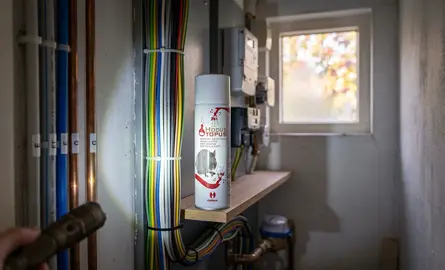
Hocus Topus is a spray for cables, pipes and plastic parts. It contains a bitter substance that deters mice and rats as soon as they start to gnaw. They quickly learn that the treated cable tastes bad and leave it alone. The spray is suitable for electrical cables because it does not conduct electricity.
How to use the spray in your car:
- Switch off the engine and let it cool. Never spray on a warm engine or near hot parts such as the exhaust manifold.
- Clean the cables. Wipe away dust and dirt so the coating adheres better.
- Spray evenly. Hold the can 15 to 20 centimetres away and treat the cables, hoses and plastic covers you can easily reach.
- Repeat in time. The effect lasts up to about four weeks, depending on humidity and temperature. If you see new signs, treat again.
Always follow the instructions on the packaging. If you are unsure about a part, ask your garage which cables and hoses are better left untreated.
Hocus Topus also works outside the car: on cables in the crawl space, pipes in the shed or the caravan in winter storage. See all products in the rodents category.
Frequently asked questions
How can I tell whether it is a mouse or a marten?
Mice leave small black droppings and nesting material and make fine, frayed gnaw marks. A stone marten bites larger pieces out of hoses and insulation and often leaves bigger droppings or food scraps. Hocus Topus is intended for rodents, so mice and rats. If you suspect a marten, talk to your garage.
Does car insurance cover damage caused by mice?
That depends on your policy. Some comprehensive policies cover gnawing damage to cables, others do not, or only cover the direct damage. Check your policy terms or ask your insurer before you have the repair carried out.
How often should I treat the cables?
The effect lasts up to about four weeks. In autumn and winter, when mice look for a warm place, it makes sense to treat the cables again every month and check under the bonnet in between.
Can I also use the spray in the garage or caravan?
Yes. Hocus Topus is suitable for cables, pipes and plastic covers in the garage, shed, crawl space and caravan. Preferably treat cables that are not live, and follow the instructions on the packaging.
Want to stop mice from chewing on your car this winter? Take a look at Hocus Topus or the other products in the rodents category.